Margin note
Filmed in one continuous take.
Share
She starts at midnight because that is when the city finally stops asking her for things. By then the emails have stopped, the street is quiet, and the kiln has cooled enough to open.
Inside the Night Studio is a fourteen-minute film about Ottilie Brandt, a ceramicist who works out of a former locksmith’s shop on Wexley Road. It was filmed in one continuous take on a cold Tuesday in February, starting at seven minutes past midnight. Nobody spoke to her while the camera was running, and she said nothing to us.
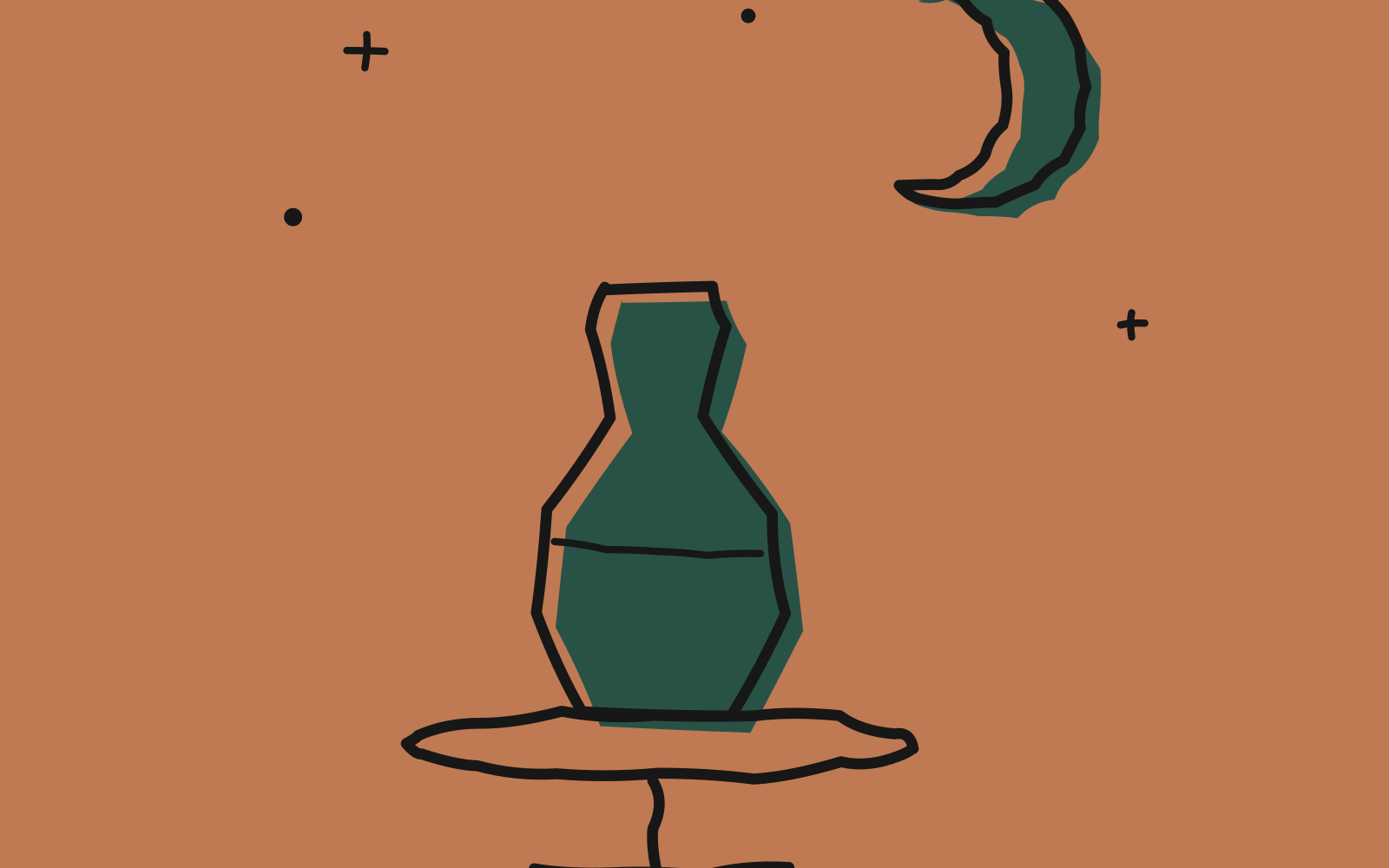
Fig. 2. Ottilie Brandt’s wheel, a little after midnight. Drawing by Almanac.
About the film
We set up a single camera on a tripod and let it run for fourteen minutes, from the moment she switched on the desk lamp to the moment the kiln door swung open. There are no cuts, no music and no interview. Just the sound of the wheel, the radio murmuring in the next room and her hands working.
The kiln had in fact been cool enough to open for about an hour when we started. Ottilie doesn’t open it straight away. She throws something first, every time, so that whatever has come out of the fire has something new to be measured against. She calls this paying in before you take out.
She has been throwing at night for eleven years, since her daughter was born and the days stopped belonging to her. She told me, the week before we filmed, that she has come to prefer it. At night the work stops being a performance. There is no one to show it to, so it only has to be right.
At night the work stops being a performance. There is no one to show it to, so it only has to be right.
I first wrote to her in October, asking whether I could film her at work. She said no. I asked again in November and she said no again, more briefly. The third time I asked whether I could film her at work while she ignored me completely, and she wrote back that she could probably manage that.
Ottilie Brandt’s work
Ottilie grew up in a seaside town she will only describe as the one with the bad pier, and came to clay late, at twenty-nine, after ten years in the office of a firm that made industrial ovens. She says the job taught her more about kilns than art school would have, and since she never went to art school she has no way of checking. In 2014 she took on the locksmith’s shop when its owner retired and offered it to the first person who didn’t want to turn it into a flat.
Pots for use
The shop still has its key-cutting bench, which she uses for glazing. She makes useful pots only: bowls, jugs, mugs with a thumb rest, a lidded jar for salt. Her glazes are few and dark. There is a treacle brown, a green she calls pond, and an iron red that works about one firing in three.
She sells through one shop in the old market hall and through a list of around four hundred people who get an email twice a year, when she has enough to sell. She once turned down a department store that wanted three hundred identical mugs by September. She told them she could make three hundred mugs or identical mugs, but not both.
Her daughter, Ivy, is eleven now and sleeps through the noise of the wheel. For the first few years Ottilie worked with a baby monitor balanced on the shelf beside the radio, which is the only reason there is a radio at all.
Planning a single take
A single take sounds simple and isn’t. We visited the studio four times before the night itself, always after eleven, to learn where the light fell and where it didn’t. The desk lamp is the only light in the film. It is an old green enamel lamp with a 60 watt bulb and a shade bent back to point at the wheel, and it decided almost everything, starting with where the camera could stand.
We used one camera with a 35mm lens at a fixed height of 110 centimetres, about the eye level of someone sitting on the stool by the door, which is where her daughter used to sit and watch. We ran the camera off the mains, because I didn’t trust the batteries. The cable is visible in the bottom left of the frame for the whole film. We decided to leave it.
One false start
We had one false start. On the Tuesday before, at about four minutes in, a fox went through the recycling bins in the yard behind the shop and Ottilie laughed, which she said afterwards she could not allow herself to do on camera. We stopped, drank some tea, and agreed to come back in a week.
The one thing we could not plan was her. We asked Ottilie to work exactly as she would if we weren’t there, pressed record, and left the room. I watched on a monitor in the kitchen for fourteen minutes, trying not to make the floorboards creak.
The first seven minutes
Before you watch
The notes that follow are keyed to the finished film, and a few of the details in them come from our conversation afterwards rather than from anything you can see on screen. The film itself explains nothing. If you would rather meet it cold, skip ahead to In her own words and come back later.
00:00 The lamp. The film opens in near darkness. You can hear the fridge and a car passing on Wexley Road. At eleven seconds she switches the lamp on and the room appears in a small circle: the wheel, a bucket, a board with six balls of clay already wedged and waiting.
01:05 Water. She fills the bucket at a sink just out of shot, and you hear it running for nearly forty seconds. I asked her about this afterwards. The tap runs brown at night for a while, she said, and she waits for it to clear.
02:14 The wheel starts. The first ball of clay hits the wheel head with a slap that is the loudest sound in the film. Centring takes her a little over a minute. Watch her left elbow, braced against her knee, which does not move at all.
03:31 Opening. Both thumbs go into the centre of the clay and the wheel slows slightly. On the microphone under the tray you can hear her breathing, in for four and out for four, which she says she does not know she does.
04:40 The first pot. A cylinder about twenty centimetres tall, pulled up in three passes. She cuts it free with a wire, sets it on the board and looks at it for twenty-six seconds without touching anything.
05:47 The second cylinder. It is almost exactly the same as the first, and she collapses it with one press of her palm. When I asked why, she said there was nothing wrong with it. She just did not need two.
The last seven minutes
06:52 The radio. A late presenter reads the weather for the coast, gales and then easing, and she stops to listen. It is the only time in the film she looks away from the wheel.
07:40 Rhythm. Three balls of clay in quick succession, a small jug and two cups, each one centred, opened and pulled in under a minute.
08:30 Two bowls. She throws them quickly, then cuts the second one clean in half with the wire to check the thickness of the wall. It was the only moment I flinched while watching. Both halves go back in the clay bucket.
09:56 A song. The radio plays something with a slow piano, and for about six seconds she hums along. It is the only sound she makes in the whole film. She says she doesn’t remember doing it and would like it cut, and we have politely declined.
11:18 Looking. She sits for almost two minutes with the first bowl, turning the board a quarter turn at a time, then wets one finger and runs it once around the rim. On the monitor I saw nothing change. On a large screen, months later, I still can’t. She says the rim was a millimetre proud on one side.
13:02 The kiln. She wipes her hands, crosses the room and kneels by the kiln in the corner, right at the edge of the lamp’s circle. The door is heavy and she opens it slowly, with both hands. Warm air comes out, and you can see it moving the dust in the light. The film ends with her face lit from below by whatever is inside, which we never see.
14:00 The end. There was no cue. We had agreed beforehand that the camera would stop at fourteen minutes whatever was happening, and this is what was happening.
In her own words
We talked a week after the shoot, at her kitchen table. What follows is from that conversation, lightly trimmed, with my questions taken out.
“People ask if it’s lonely at night. It isn’t, really. The radio is company, and the street has its own regulars. There’s the last bus, which turns round at the end of Wexley Road at twenty past twelve, and the man from the flats who walks a very old dog at one. I know all of them and none of them know me, and that suits me fine.”
“I forgot the camera after about two minutes, which surprised me. I’d expected to be stiff. What I couldn’t forget was Kenji in my kitchen, because that floor goes off like a gun, and he stood perfectly still for the whole thing. I could feel him standing still.”
“Everybody asks about the bowl I cut in half. It was a good bowl. But I didn’t know it was good until I cut it, and now I know the next one will be good too. You pay for knowing. That’s most of the job, if I’m honest, paying for knowing.”
“The rim, yes. It was proud on one side. You won’t see it. Someone drinking from that bowl would feel it on their lip, and they wouldn’t know what they were feeling, they’d just like the bowl slightly less. I’m not making pots for a camera. I’m making them for a lip.”
I’m not making pots for a camera. I’m making them for a lip.
“I don’t know if I’ll still work at night when Ivy leaves home. Maybe I’ll try days and find out I hate them. I’ve kept the lamp, anyway.”
Why we filmed it this way
Most films about craft are edited to feel productive: a pot goes from lump to glaze in ninety seconds. We wanted the opposite, a film that asks you to sit with the time the work actually takes.
Not everyone agrees with the choice, and I am not sure they are wrong. One early viewer wrote to us with a verdict:
Fourteen minutes of someone making pots without explanation is a screensaver with ambitions.
An early viewer, by email
I have that printed out above my desk. I would only say that a screensaver does not stop to listen to the weather.
Credits and thanks
Role | Name |
|---|---|
Directed and filmed by | Kenji Arai |
Featuring | Ottilie Brandt, who also chose the radio station |
Sound | Pell Varga, mixed very lightly in a spare bedroom |
Colour | Joanna Teague |
Captions | Mina Oduya |
Produced for Almanac by | Ines Vautrin |
With thanks to the residents of Wexley Road for putting up with a parked car and a stranger in the kitchen until one in the morning, to the fox, and to Ottilie’s daughter, who lent us the stool. Filmed in one continuous take on 13 February, between 00:07 and 00:21.
It is fourteen minutes long. We recommend watching it at night, with the lights down.