Margin note
A follow-up to our 2024 issue on workshops.
Share
Every workshop has a drawer of tools nobody uses. Ask about them and you will hear a story: a grandfather, a first apprenticeship, a job that went wrong in an instructive way.
Two years ago we published an issue about workshops, and the letters that came in afterwards were almost all about drawers. Not benches or lighting or the smell of linseed oil, which is what I had expected, but the drawer under the bench where the odd things go. So this spring I went back. We visited six makers, a joiner, a bookbinder, a luthier, a blacksmith, a ceramicist and a watch repairer, and asked each of them the same question: which tool would you save from a fire?
It is a slightly unfair question, and two of them told me so. The blacksmith pointed out that his whole building is designed around fire, that it has burned down zero times in thirty years, and that if it did he would save the cat.
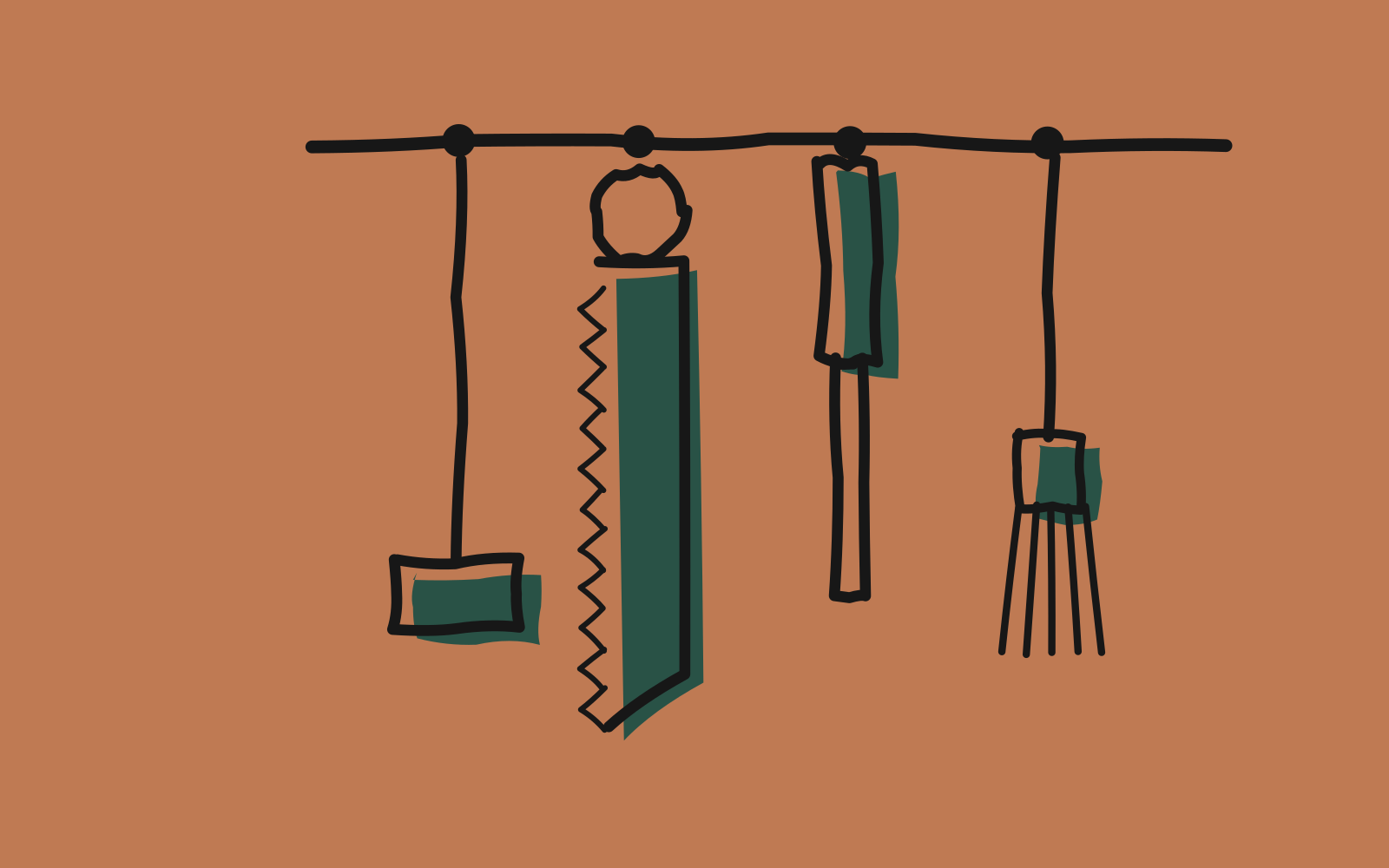
Fig. 2. The wall above the bench, where the old tools hang within reach. Drawing by Almanac.
Not the best, the oldest
Almost nobody chose their best tool. The joiner chose a spokeshave with a cracked handle that had belonged to his teacher. The bookbinder chose a bone folder worn into the exact shape of her grip. The watch repairer chose a pair of tweezers he admitted he no longer trusts for fine work.
Aurel’s spokeshave
Aurel Fenwick makes chairs in a railway arch on Coldharbour Yard, and apologises for the trains before they arrive, as though he had booked them.
The spokeshave is a beech-handled thing about the length of a hand, with a split running down one side that has been glued at least twice, once well and once badly. Aurel’s teacher, a man called Desmond who ran a shopfitting business until 1991, gave it to him on his last day as an apprentice, wrapped in the racing pages. “He said it was the only tool in the shop that had never been dropped,” Aurel told me. “Which was a lie. You can see where it’s been dropped.” He still uses it most weeks, for chair spindles. He says it cuts slightly to the left, and that he cuts slightly to the right to make up for it, and that after twenty-two years he no longer knows which of them is correcting the other.
He has an apprentice of his own now, Pru, who is twenty-three. I asked whether the spokeshave would go to her one day. He said probably, though he would need to think of a lie to tell her when it did, and it would have to be a better one than Desmond’s. Pru, sanding a seat at the far end of the arch, said without turning round that she had heard that.
A bone folder from 1997
Saskia Moll has been binding books for twenty-nine years, the last fourteen of them above Dunmore Print. Most of her work is repair: family bibles with the boards hanging off, cookbooks that have been opened flat on a counter so many times the spine has given up.
Saskia’s bone folder is the colour of weak tea and has a shallow dip on one face where her thumb goes. It was new in 1997, from a supplier in the old covered market that closed the following year. She owns six other folders, two of them plastic, which she says are better for most jobs. She would let all six burn. Saskia put it better than I can. “A new tool does the job. An old tool remembers every job it has done, and some of that memory ends up in your hands.”
A new tool does the job. An old tool remembers every job it has done, and some of that memory ends up in your hands.
She showed me what she meant. She creased one sheet of heavy cotton paper with a plastic folder and a second with the old one, and asked me to run a finger along both with my eyes shut. I guessed right twice out of three, which is about what a coin would manage. What I could see, with my eyes open, was her hand. With the plastic folder she gripped. With the old one she hardly held it at all; it sat in the dip it had worn, and the crease went down in a single pass.
What they were really saving was continuity. A tool that has been used for forty years carries the habits of everyone who held it. Using it is a way of keeping those people in the room.
The tweezers he doesn’t trust
The watch repairer’s answer is the one I keep thinking about. Bernard Oyelaran has a shop on Quay Parade with a bell on the door and a handwritten sign that says NO BATTERIES, WE ARE NOT THAT KIND OF SHOP. His tweezers are brass, and the tips no longer meet perfectly.
So why save the old tweezers? He thought about it for long enough that I wondered if I had offended him. Then he said that they were the first thing he ever bought with his own wages, in 1979, for eleven pounds, and that it seemed rude to throw them out just because they had got old. “I am also not as good as I was,” he said. “Nobody has thrown me out yet.”
Before I left he did something I have thought about since. A customer had dropped a plain steel wristwatch from the fifties on a tiled floor, and Bernard opened it and talked me through the damage with the old tweezers, pointing at each bent part and never touching. Then he put them down and picked up the new pair to do the actual work. So the old ones are still used every day. They have just been promoted to pointing.
The cat and the tongs
Gil Arden’s forge is on the edge of Sallow Cross, in a former bus depot with a roof high enough to let the smoke make up its own mind. The cat is called Smut. She is fourteen, black, and sleeps on a shelf directly above the power hammer, which tells you something about either the cat or the hammer.
Gil did not really play along. He gave me the cat, and then, when pressed, a pair of tongs he made in his first month at the forge. They are badly balanced and slightly too long, and he uses them only to show students what badly balanced tongs feel like. I liked this very much. It is a tool kept on purpose as a mistake.
He let me hold them over the anvil with nothing in the jaws. Within about a minute my forearm had started to ache somewhere I did not know I had. Then he handed me a pair he made last year, and the ache went away. “Everybody makes these tongs,” Gil said. “The only question is whether you keep them.” His theory is that a craft is mostly a list of mistakes you no longer make, and that you forget the list unless something on a hook reminds you.
Half a hacksaw blade
Noor Halloran makes bowls and plates in a garage behind her terraced house on Mill Row, four minutes from Bernard’s shop, in a pale speckled stoneware with a glaze she calls oatmeal and her customers call beige.
She chose a strip of old hacksaw blade that she uses to trim the feet on bowls. It cost nothing. It came out of a skip outside a garage in 2008. She has tried to replace it with a proper trimming tool four times, and each time she has gone back to the blade, which has been ground and reground until it is about half its original width.
She trimmed a few bowls while I watched. The blade made a sound like someone tearing paper very slowly. Her proper tools, loop tools with wooden handles, are still in a drawer. She says they are perfectly good and that the blade is better, because it is thin enough to feel the clay through. Then she said that might just be what she tells herself.
On the way out I mentioned that Bernard’s shop was round the corner. She knew it. She had walked past it for nine years and never gone in, because she had never owned a watch worth mending. A week later she emailed to say that she had taken in her grandfather’s pocket watch, and that Bernard had pointed out everything wrong with it using a pair of tweezers he clearly did not trust.
The ones who wouldn’t choose
Tomasz Reeve, the luthier, refused to choose at all, which I suspect is the honest answer, and then walked me round the converted dairy where he builds guitars for forty minutes, explaining why each of the alternatives would be the wrong one. It would be tidier to say that everyone chose an old tool, and that isn’t quite true. Five out of six did, if you count the tongs, which I do. Here is how the six answers came out.
Maker | Trade | Tool | Since |
|---|---|---|---|
Aurel Fenwick | Joiner | Spokeshave with a cracked handle | Twenty-two years |
Saskia Moll | Bookbinder | Bone folder | 1997 |
Bernard Oyelaran | Watch repairer | Brass tweezers | 1979 |
Gil Arden | Blacksmith | His first tongs, after the cat | His first month |
Noor Halloran | Ceramicist | Half a hacksaw blade | 2008 |
Tomasz Reeve | Luthier | Refused to choose | Not applicable |
Tomasz’s argument was simple. A tool you would save from a fire is already halfway to being a relic. A plane by a famous maker goes up on a shelf, out of the dust, and its owner buys a cheaper one to do the work.
So the good one dies twice. Once when nobody uses it, and again when the person who knew how to use it isn’t there.
Tomasz Reeve, luthier
He would rather wear everything out, and he pointed at a scraper that had been sharpened down to the width of a playing card.
A tool you would save from a fire is already halfway to being a relic.
I think he is at least partly right, and it unsettled the rest of my trip a little. Every tool I was shown had come with a story ready, and a story is a kind of shelf. Saskia’s folder is still in daily use, and so are Aurel’s spokeshave and Noor’s blade. But Bernard’s tweezers have been retired to pointing, and Gil’s tongs exist to be held badly. Perhaps I had been collecting relics and calling them tools.
The drawer as archive
We came away thinking of that drawer differently all the same. It is not clutter. It is an archive, organised by feel rather than by date, and it holds the history of a craft more faithfully than any book about it.
Books about craft tend to describe the right way to do things. The drawer holds the actual way, which is full of repairs and improvisations and things that only work if you hold them at a slight angle. Desmond’s spokeshave records a habit of cutting a little to the left. Bernard’s tweezers record a hand that was steadier in 1985. Noor’s blade records eighteen years of bowls, and if you look at the wear closely you can tell that she trims clockwise.
My own drawer
I have my own drawer, it turns out. It is in the kitchen, under the cutlery, and it holds a pencil from my grandmother’s house, a letter opener nobody has ever used to open a letter, and a steel ruler from the first office this magazine rented, on Hollins Row, with the landlord’s phone number written on the back in biro. I do not use any of them. I would save the ruler, and I could not tell you why with any confidence.
I rang the number on the back, in the end, on a wet Thursday in May. It belongs to a hairdresser now. She was very nice about it.
How we reported
We visited the six workshops over five weeks this spring, one or two a week, with a notebook and Kenji Arai’s camera. Every maker read their section before we went to print. Bernard asked for one change, to the price of his tweezers, which we had written down as twelve pounds. It was eleven.