
Margin note
Printed as a zine for our patrons.
Share
Screens are brilliant at many things. Being put down is not one of them.
Every season we print a small zine for our patrons: forty pages, two colours, stapled by hand on a kitchen table. It costs more than it should and takes longer than it needs to. It is also, by some distance, the thing our readers write to us about most.
I want to try to explain why, partly because people keep asking and partly because I am the one who has to justify the print bill every quarter, and I would like the argument written down somewhere other than inside my head at two in the morning.
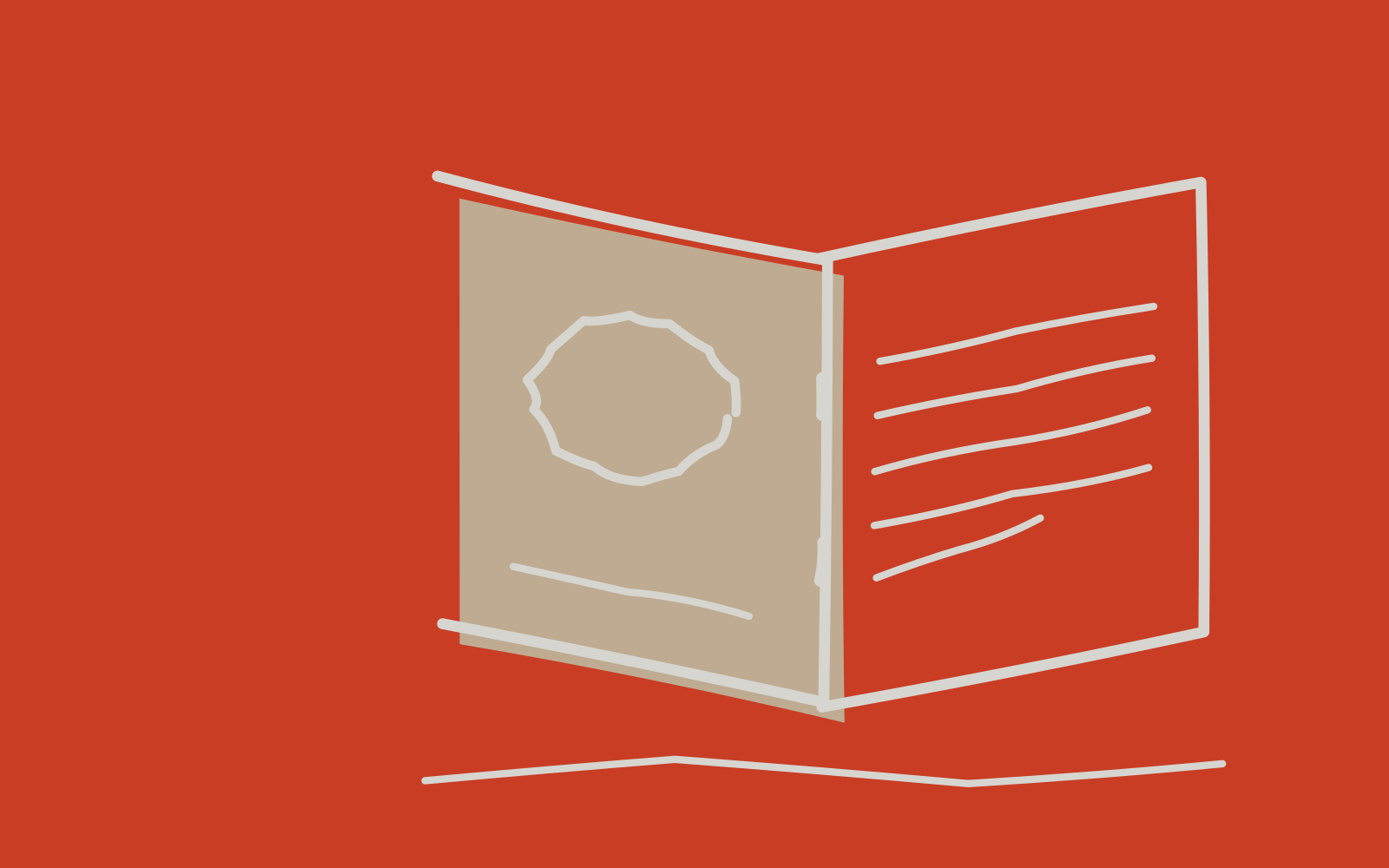
Fig. 2. A spread from the autumn zine, folded by hand. Drawing by Almanac.
The edges matter
Paper ends. It has edges. When you finish a printed page there is nothing more to scroll to, no related article, no autoplay. The page simply stops and lets you think.
I noticed this properly for the first time on a train. I had a proof of the autumn issue on my lap, and when I reached the end of an essay I just sat there and looked out of the window at a reservoir. Nobody had decided, on my behalf, that I would probably also enjoy something. For about four minutes it was simply over, and I was left alone with what I had read.
A printed page is finished in a way no screen can be. It waits on the table and asks nothing of you. You can leave it open on the arm of a sofa for a week and it will be exactly where you left it, at the same sentence, not having updated itself or been corrected or quietly replaced by a newer version with a better headline.
A printed page is finished in a way no screen can be. It waits on the table and asks nothing of you.
This is a small thing, and possibly the whole thing. A screen is a window onto something that never stops. A page is an object that does. One of our patrons told me she keeps each issue in the bathroom for exactly three months, until the next one arrives, and then moves it to a shelf in the hall.
Attention without numbers
There is also the matter of attention. A zine does not notify you. It does not know how long you spent on page twelve. It cannot be optimised, which means it can only be good or not good, and that is a healthy pressure for a publication to be under.
Online, we know far too much. I can tell you that the average reader of last month’s longest essay got about sixty per cent of the way down. I am not convinced any of this has made us better at our jobs. It has certainly made us more nervous.
With the zine we have nothing. A box goes out, and for about three weeks there is silence, and then the letters start.
The letters
Actual letters, some of them, on paper, which feels like a joke being played on us. A man in Dunmere wrote four pages about a single photograph of a harbour wall. A woman wrote to tell us that page thirty-one had a typo, which it did, and that she had corrected it in biro and was happy with the result. I have no idea how many people read the whole thing. I have a much better idea of what they thought of it.
The man in Dunmere turned out to be a retired harbourmaster called Leonard Quill. He identified the wall in the photograph to within about ten metres, told us it had been rebuilt in 1953 after a storm took the old one, and enclosed a pencil sketch of how it looked before. He has written after every issue since, always four pages, always ending with a short paragraph about his tomatoes.
We keep the letters in a biscuit tin, and then, when that filled up, a second biscuit tin. A teacher in Carrick photocopied an essay about bus timetables for her class of fifteen-year-olds and then posted us twenty-three notes from the students, most of which said some version of “I didn’t know buses were political”. A postcard last spring said only “More of the bus one.”
Not all of them are kind. Someone wrote that the orange in the autumn issue made their eyes hurt, and they were right. Someone else wrote, at length, that we had become smug, and I read that one three times and then put it in the tin with the others. Samira, who looks after our patrons, replies to every letter by hand.
At Hallam & Pike
The process is less romantic than it sounds. We lay the issue out over about ten days, then send it to a riso printer called Hallam & Pike, who work out of an industrial unit behind a tyre place. They print in two colours: always a dark blue, and one other that changes each season.
Hallam & Pike is Dot Hallam and one part-time assistant. There is no Pike any more. He left in 2015 to keep bees, and Dot kept the name because the sign cost three hundred and forty pounds and she wasn’t going to pay that twice.
A riso works more like a stencil than a printer: each colour is a separate drum, swapped in and out by hand, and each sheet goes through once for every colour on every side. Six hundred copies means twenty-four thousand passes. It takes Dot the best part of two days.
The ink never quite dries. For about a day after printing it will come off on your thumb, which is why every issue has at least one fingerprint somewhere, usually mine.
The second afternoon
I go out to the unit on the second afternoon to check the run. Dot hands me a copy still warm from the drum and a mug of tea that says “Second Best Printer In The County” on the side, and we stand by the radiator and turn the pages without speaking, which I have come to think of as a kind of proofreading.
The kitchen table
Then six or seven of us spend a Sunday at my kitchen table collating, folding and stapling with a long-arm stapler that jams on roughly every fifteenth copy.
The sheets go in piles around the table in page order, and people walk round it, picking up one of each, like a very slow buffet. Someone folds, with a bone folder that belonged to my grandmother and is the only genuinely good tool we own. Someone staples.
None of us is especially good at stapling. I have stopped minding. There is something useful, I think, in a publication that physically cannot be perfect, made by people eating toast over the spare copies, with the radio on and Kofi’s dog, Moss, asleep under the table on the cover proofs.
What it costs
Each copy costs us about £3.80 to make and post, which is more than we can sensibly defend on a spreadsheet. We print six hundred. Postage is the big one, at £2.40, because the zine is just thick enough to count as a large letter. Across four issues a year that is a little over nine thousand pounds.
Item | Cost |
|---|---|
Printing and making one copy | about £1.40 |
Postage, as a large letter | £2.40 |
Each copy, made and posted | about £3.80 |
One issue of six hundred copies | about £2,280 |
A year of four issues | a little over £9,000 |
The zine goes to the patrons who pay six pounds a month or more, of whom there are currently around five hundred and forty. Those patrons cancel at less than half the rate of everyone else. This is the number I lead with every quarter, and I know it isn’t quite honest. People who pay more are keener to start with. I have never found a way to tell the difference, and I have stopped pretending I can.
At least once a year someone sensible suggests we send a PDF instead. It would cost almost nothing. I have tried to imagine Leonard Quill printing out a PDF, and I can’t.
What printing does to editing
The most useful thing about paper, for us, is what it does before anything is printed. Online there is no shortage of space, so nothing is ever cut for length. When a piece runs long there is no real cost, only a slightly lower number at the bottom of a dashboard that nobody reads closely.
Forty pages changes that. Somebody has to choose one photograph of the coast out of eleven. We argue about single sentences, and about whether a footnote has earned its two lines. We cut the sentences that only exist because space is free, and almost every time the piece is better for it.
The bus timetable essay is a fair example. Its fourth section was a long and genuinely interesting history of a single route, the 41, and it had to go because it was four pages and we had two. The writer was upset for about a day. Then she read the shorter version on paper and wrote to say it was the first time she had understood what the essay was actually about, which was not the 41 at all but the people waiting for it.
From the archive
The bus timetable essay ran at two pages in print. The full version, including the long history of the 41 that we cut for the zine, is in our online archive. Patrons who would like an accessible copy of any issue can ask Samira, who will send one free.
The case against
My friend Oskar Lind runs a publication about housing that has eleven thousand subscribers and has never printed a single page. We had lunch in October, where he ordered soup and then didn’t eat it because he was too busy disagreeing with me, and it is only fair to set his case down here.
His first point was that the zine is a club. It goes to the people who can afford six pounds a month, in this country, with a letterbox. Readers who use a screen reader get nothing. Then he put it more plainly:
Your best work goes to your richest readers, and you’ve made a virtue of it.
Oskar Lind, over lunch in October
Since that lunch we have started sending a free accessible copy of each issue to anyone who asks, and six printed copies to the library in Dunmere. That narrows the gap. It doesn’t close it.
His second point was that the edges I keep talking about are an editorial choice, not a property of paper. Screens can stop, he said. Most publishers just choose not to let them. I think he is right about this, and I also think the fact that almost nobody makes that choice is more or less my point.
His third point was the letters. “You’ve built a feedback channel for people who own stamps,” he said, which made me laugh and then annoyed me for about a week. He is right that the people who write letters are not a fair sample of anyone. I would say only that a stamp is a small act of effort, and that effort tells you something a dashboard can’t. But I would say that.
Not nostalgia
None of this is nostalgia. I have no particular feelings about typewriters, and old books mostly smell of damp. We publish online first, and most people will only ever read us on a screen, which is fine. The screen is where you can search, and link, and find something we wrote in 2019. It is very good at that, and I would not give it up.
But printing forces us to edit harder, choose fewer images and cut what we would otherwise leave in out of politeness. We think that is a feature, not a limitation. The screen gets the archive. Paper gets the best of it.
The screen gets the archive. Paper gets the best of it.
The winter issue goes to the printer on the fourteenth. The second colour this time is green. I have seen the swatch, and I am trying to stay optimistic.

